AC repair in Stockton
Warm air from the vents, a silent outdoor unit or frost on the copper line usually traces back to one part, and a C-20 licensed technician can normally name it on the first visit. In a Stockton summer the culprit is often a cheap starting part, not the compressor.
On this page
Why the starting parts go first here
Stockton Metropolitan Airport logged 61.3 afternoons a year at 95°F or above across 2016-2025, and the average July high is now 96.8°F. Then the Delta breeze arrives, the evening falls toward 61.1°F and the compressor finally shuts off. Every hot day is one long run followed by a lot of cycling on and off, and every cycle leans on the small electrical parts that get the outdoor unit moving. So the repair list in this city skews toward those parts.
Match what you see to the likely part
- Outdoor unit buzzes, fan sits still. Usually the capacitor, the small canister that jolts the compressor and fan motor into motion. Fixr prices replacing one at $100 to $400.
- Thermostat calls for cool and nothing outside happens, or the unit never shuts off. Look at the contactor, the relay that switches the condenser on and off. Its contacts burn and stick after enough summers. This Old House puts relay and contactor jobs at $100 to $450.
- Compressor hums, top fan dead, unit quits after a few minutes. A condenser fan motor that has given out means the heat has nowhere to go, so the unit trips on its own safety. This Old House lists the motor at $300 to $800.
- Runs all day, never quite cools. Check the outdoor coil. Stockton summers are dry, so dust, cottonwood fluff and leaf litter just pile up on the fins, and the system works longer and hotter to get rid of the same heat.
- Warm air with frost on the suction line or indoor coil. Often low refrigerant, which means a leak somewhere. A top-off with no leak search just buys you the same bill next July. Fixr has leak repair at $200 to $1,500.
- Puddle by the air handler in the garage, or a stain under the attic unit. The condensate drain is plugged. Cheap if someone clears it before the water gets into drywall.
- Loud clunk at startup, breaker trips, nothing cools. This can be the compressor, and Fixr puts that at $600 to $3,000. Once a compressor is on the table for an older unit, so is a replacement quote.
Five minutes of checking first
Run through this list before booking. Now and then it ends the problem on the spot.
- Thermostat: mode on Cool, setpoint a few degrees under the room, fresh batteries if the screen is faint or blank.
- Electrical panel: the furnace or air handler and the condenser each have their own breaker. One reset is fine. A second trip means stop and book the visit.
- Filter: a choked filter starves the indoor coil of air until it ices over. Swap it.
- Ice anywhere: switch the system to Off and the fan to On and let it melt for a few hours. A frozen system left running can ruin the compressor.
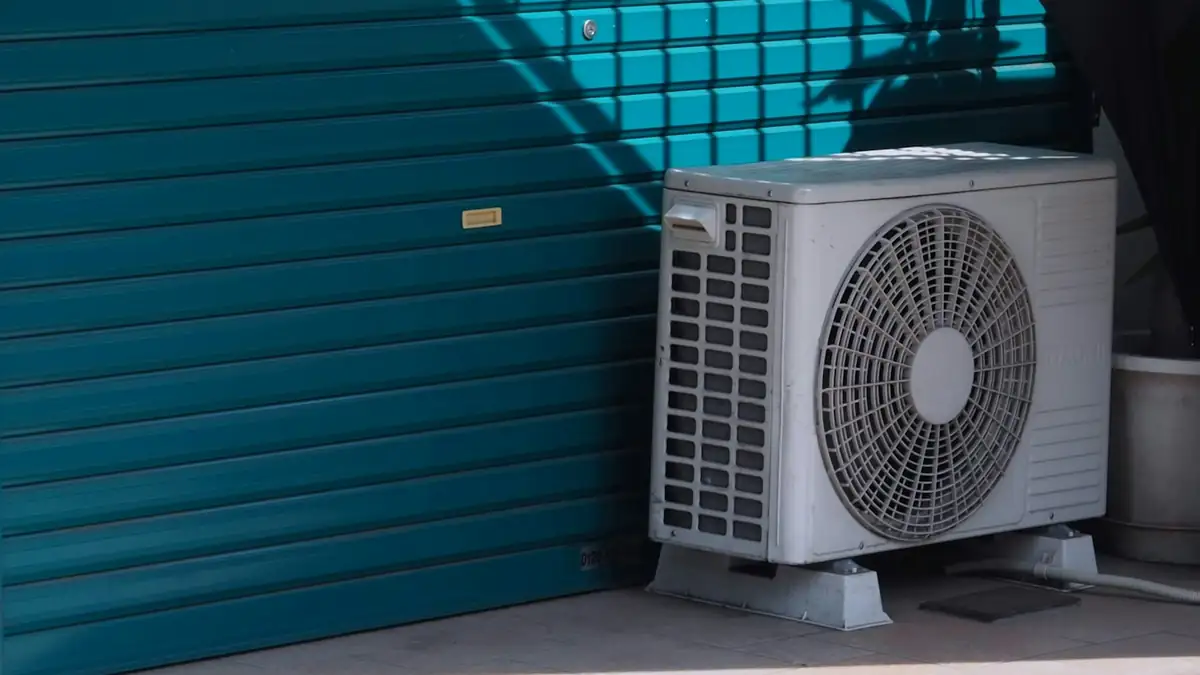
- The condenser in the side yard: fan turning? Fins caked or crowded by shrubs?
Leave the service panel on the outdoor unit closed. The capacitor behind it can still shock you after the breaker is off.
Running all afternoon is not always a failure
On a 105 degree day an older system can run nonstop from lunch to dinner and still lose a few degrees. That alone doesn't mean it is broken. The better test is the evening. Once the sun is down and the air outside falls into the 70s, a healthy system should pull the house back to the setpoint. If it is still running at midnight and losing ground, or the air at the vents feels barely cool, book the visit.
Price ranges to expect
Across the country, Fixr's 2026 numbers have the typical AC repair at $250 to $700 and the average near $375, while This Old House pegs most common fixes at $150 to $650. Neither is a Stockton figure; they are a yardstick. Expect a separate charge for the diagnostic visit too, and ask up front whether it gets credited if you approve the work. The full price table lists more parts, and is this AC quote fair? helps you read a quote already in hand.
Who can do the work
In California, HVAC work over $1,000 in labor and materials, or any job that needs a permit, takes a contractor with the right license. For air conditioning that is the C-20 classification from the Contractors State License Board. Most real repairs clear the $1,000 line once the trip and labor are counted, so ask for the license number and look it up.
When a repair stops making sense
Once a system is in its teens and the diagnosis is a compressor or coil, ask for a price on a new system before you sign off on the fix. How to decide.
Questions Stockton homeowners ask
Why is my AC running but blowing warm air?
In Stockton the usual suspects are a dead capacitor or condenser fan motor, an indoor coil iced over behind a dirty filter, refrigerant lost to a leak, or a thermostat left on Fan instead of Cool. Look at the filter and both breakers before calling.
Why does my outdoor AC unit hum but not start?
Start with the capacitor, a frequent cause of that hum. It keeps a charge after the power is cut, so let the technician handle it rather than opening the panel.
Can a handyman fix my AC in California?
Only for very small jobs. California lets an unlicensed person do work under $1,000 total in labor and materials, with no employees and no permit. Anything bigger, or anything needing a permit, requires a licensed contractor, which for AC is a C-20.
Sources
- Fixr: AC Repair Cost in 2026 (updated January 29, 2026)
- This Old House: Air Conditioner Repair Cost, 2026 Pricing (updated March 16, 2026)
- CSLB: Handyperson Exemption to Increase to $1,000 in 2025 (AB 2622, December 30, 2024)
- CSLB: C-20 Warm-Air Heating, Ventilating and Air-Conditioning classification (accessed October 29, 2026)
- California Contractors State License Board: check a license (accessed October 29, 2026)
- NOAA NCEI daily summaries, Stockton Metropolitan Airport (USW00023237), accessed October 29, 2026